


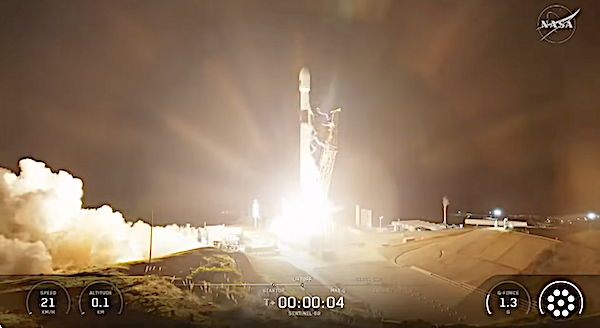

SpaceX launched NASA’s Sentinel-6B mission from Space Launch Complex 4 East (SLC-4E) at Vandenberg Space Force Base in California, Sunday, November 16. Photo captured by Satnews.
Sentinel-6B is the second of twin satellites in the Copernicus Sentinel-6/Jason-CS mission. The first, Sentinel-6 Michael Freilich, launched in November 2020. The mission continues a decades-long effort to monitor global sea level and ocean conditions using radar to make precise measurements from space.

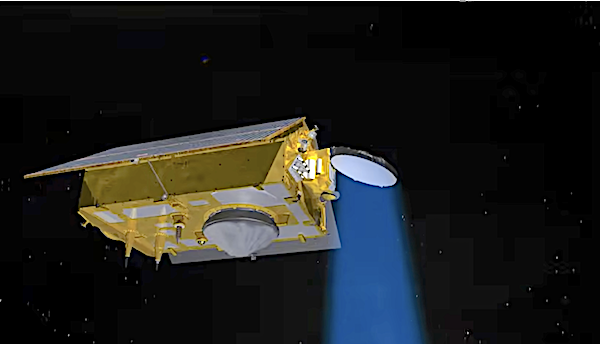
The Copernicus Sentinel-6/Jason-CS mission is a collaboration between NASA, ESA (European Space Agency), EUMETSAT (European Organization for the Exploitation of Meteorological Satellites), and the National Oceanic and Atmospheric Administration (NOAA).
Sentinel-6B will use radar to bounce signals off of the ocean surface to deliver continuous ocean topography measurements. The mission also will collect high-resolution vertical profiles of temperature to assess temperature changes in Earth’s atmosphere and improve weather prediction models. It will take over from Sentinel-6 Michael Freilich, a twin of Sentinel-6B, which Falcon 9 launched five years ago on November 21, 2020
This will be the third flight for the first stage booster supporting this mission, which previously supported two Starlink missions. Following stage separation, the first stage will land on Landing Zone 4 (LZ-4) at Vandenberg Space Force Base.


